三相电机故障查找:指南
Electric motors are the backbone of many manufacturing and processing operations worldwide. Keeping these motors in good condition and operating efficiently should be a top priority for every business.
Three-phase motors use three currents to power their internal electrical components, such as the stator, rotor, windings, and cables. When problems occur during motor operation, the components must be analyzed to pinpoint the exact location of the problem.
Understanding the basic operating principles of three-phase motors
The core of a three-phase motor lies in the intricate interaction between the stator and rotor components.
The stator consists of three windings that generate a rotating magnetic field under the influence of three-phase alternating current. This rotating magnetic field induces a current in the rotor, which in turn generates its own magnetic field. The interaction between these magnetic fields produces the torque that drives the motor to rotate.
The speed of a three-phase motor depends on the frequency of the power supply voltage and the number of poles in the motor design. By adjusting the frequency, the operator can precisely control the motor speed, thereby achieving fine-tuning control of industrial processes.
Compared to single-phase motors, three-phase motors offer several advantages, including higher efficiency, greater starting torque, and more balanced power distribution. These characteristics make them the preferred choice for a wide range of industrial applications, from pumps and compressors to conveyors and cranes.
Three-phase motor troubleshooting steps
Diagnosing and resolving problems with three-phase motors can be a complex task, but with the right tools and techniques, you can effectively identify and resolve the root causes of common motor failures.
Visual inspection
First, by carefully inspecting the actual condition of the motor, its connections, and its surrounding environment, we can often find obvious problems that may be causing issues.
Internal electrical component analysis
If the motor and its cables show no obvious damage or problems, the next step is to use specialized testing equipment to measure parameters such as winding resistance, insulation resistance, and current consumption. These measurements will provide valuable information about the motor’s internal health and help us identify any electrical faults.
Mechanical Analysis
Finally, the third stage of the fault-finding process is dynamic testing, which involves observing the motor’s performance under load. By monitoring the motor’s speed, vibration, and other operating parameters, we can identify any mechanical problems that may affect its efficiency and reliability.
Motor Analysis Tools and Techniques
Having the right tools and knowledge is crucial when maintaining and troubleshooting three-phase motors.
multimeter
One of the most commonly used instruments for diagnosing motors is the multimeter.
A multimeter can be used to measure important electrical parameters such as voltage, current, and motor winding resistance.
However, measurements of these parameters often overlook faults that can be detected by other instruments that measure impedance, inductance, phase angle, and current frequency.
Meghommeters
Another commonly used tool for motor analysis is the megohmmeter.
A megohmmeter is a type of meter that measures extremely high resistance by sending a high-voltage signal to the object being measured.
Megohmmeters provide a quick and easy way to determine the insulation condition of wires, generators, and motor windings.
However, megohmmeter insulation testing can only detect grounding faults. Since only some motor winding faults are caused by grounding faults, this method alone cannot detect many motor faults.
Surge test
Surge testing subjects the system to voltage spikes exceeding the rated input voltage to identify weak points in the insulation.
Surge testing should be avoided in motor analysis because it can damage the internal windings.
Motor Circuit Analysis (MCA™)
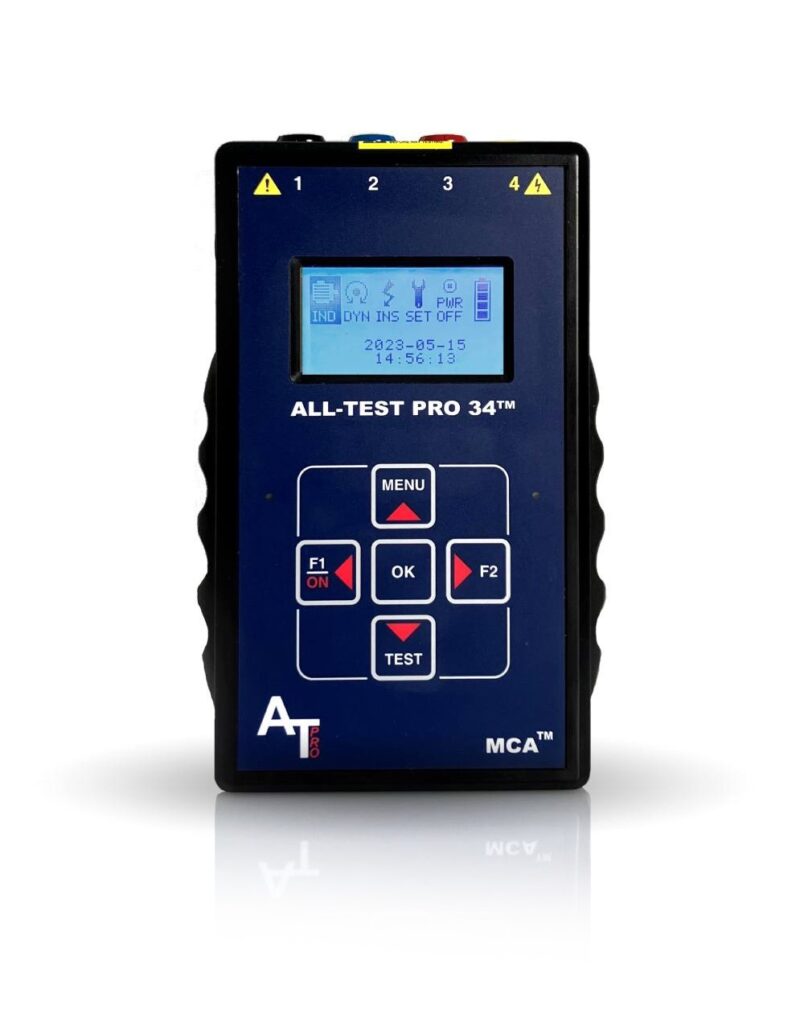
Motor Circuit Analysis (MCA™) is a non-destructive power-off testing method used to assess the health of a motor.
Starting from the Motor Control Center (MCC) or directly on the motor itself, this process evaluates the entire electrical components of the motor system, including test points and connections and cables between the motor and the test points.
Issue Meg-ohm Meter Multi-Meter ALL-TEST PRO 7 Ground Faults Internal Winding Faults Open Connection Rotor Faults Contamination

Electrical Characteristic Analysis (ESA).
Electrical characteristic analysis (ESA), including motor voltage characteristic analysis (MVSA) and motor current characteristic analysis (MCSA), is a power-on testing method that collects voltage and current waveforms during motor system operation.
Power-on testing provides valuable information for AC induction and DC motors, generators, wound-rotor motors, synchronous motors, machine tool motors, and more.
Preventive maintenance to avoid three-phase motor failures
Proper preventative maintenance is crucial to avoiding costly three-phase motor failures. By taking a proactive approach, you can extend the life of your motor and minimize unplanned downtime.
Status monitoring
One of the key steps in preventative maintenance is regular inspection. Closely monitor three-phase motors for signs of wear, such as bearing problems, insulation degradation, and imbalance.
Regular assessments of rotating machinery should be conducted through motor circuit analysis to monitor their long-term condition. Detecting and resolving early-stage faults before motor failure is crucial for the company’s production.
environment
Maintaining optimal operating conditions is equally important. Ensure the motor is not overloaded, is well-ventilated, and operates at the correct voltage and frequency. Neglecting these factors can significantly contribute to premature motor failure.
Predictive maintenance
Furthermore, implementing comprehensive predictive maintenance programs (including electrical signal analysis, vibration analysis, and thermal imaging) provides valuable data to identify potential problems before they arise. This data-driven approach enables businesses to make informed decisions and proactively schedule maintenance.
Summarize
Because the complex components of the motor are shielded inside, finding three-phase faults is a challenging task, but it can still be accomplished with the right methods and tools.
Don’t let three-phase motor problems catch you off guard. Invest in the right tools and technology, and you can keep critical equipment running smoothly for years to come.