发电厂利用电特征分析进行性能评估
A nuclear power plant in the northeastern United States relies on four vertical water pumps to supply water to a heat exchanger to cool the sealed ultrapure water/steam that drives the turbine generator.
All four identical water pumps under maintenance had 30-foot-long shafts, and two of them began to experience performance problems.
This prompted the maintenance team to conduct a performance study on the rather old vertical service pumps (which were installed when the nuclear power plant was built in the early 1970s).
The nuclear power facility’s maintenance team plans to analyze a range of measurements, including vibration, pressure, and flow. They also want to conduct electrical characterization as part of a pump performance assessment, so they contacted Bob Dunn of I & E Central; a company known for providing on-site predictive maintenance services and industrial test equipment for predictive maintenance (PdM), electrical, and reliability professionals.
Dunn went to the nuclear power plant to perform electrical characteristic analysis on two 350-horsepower, 480-volt motors.
Perform electrical characteristic analysis
By connecting a current sensor and voltage wires to the motor and then capturing high-resolution current and voltage waveforms, FFT analysis and raw waveform data analysis can be performed to conduct electrical characteristic analysis.
The data obtained from this provides in-depth insights into the entire motor system, including the mechanical and electrical systems from input power to the drive load.
This technology essentially uses the electric motor as a sensor for mechanical analysis.
Any mechanical phenomenon can be modulated onto a current waveform, allowing it to be detected and analyzed.
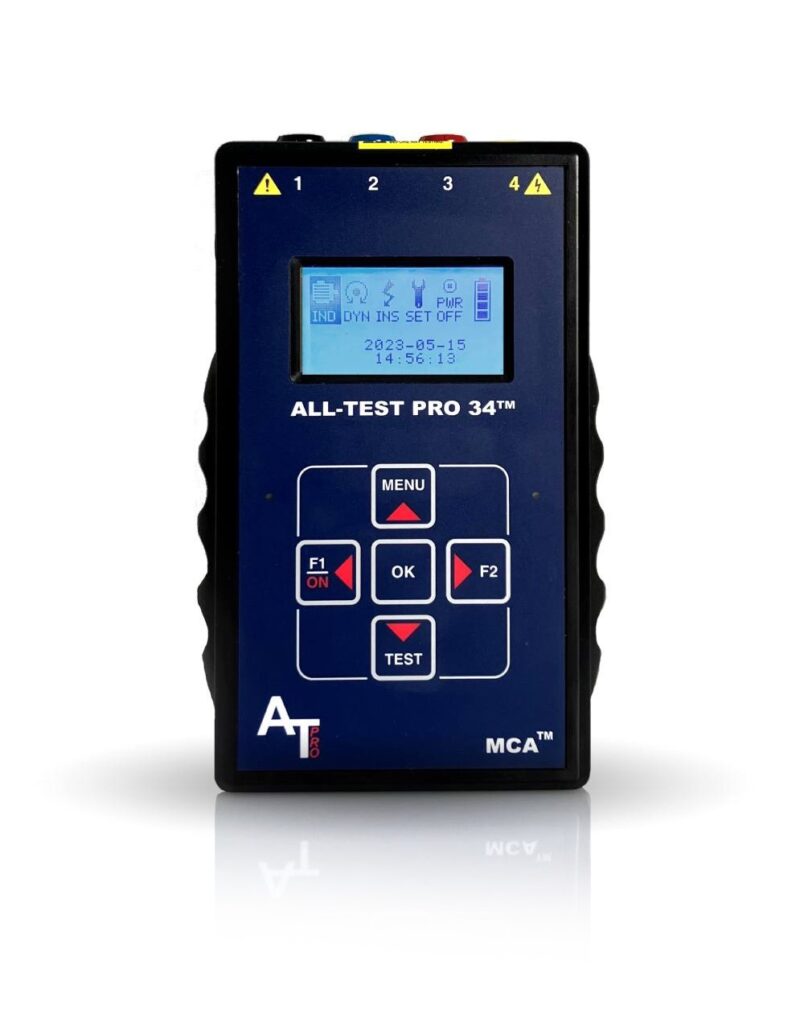
Dunn used the ALL-TEST Pro Online III™ powered motor test instrument to perform electrical signal analysis. He connected the ATPOL III™ to the system and set the test flow rate to 5600 GPM. During testing, the motor junction box remained open, and the ATPOL III™ data acquisition unit was placed near the motor. The ATPOL III™ collected and transmitted data via Bluetooth, while Dunn and the maintenance team maintained a safe distance from the high-voltage equipment.
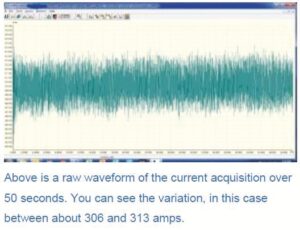
Electrical characteristic data is collected in two segments: 50 seconds of high-resolution low fmax (100 Hz) current acquisition, which mainly displays problems at operating speed (misalignment, imbalance) and problems at synchronous speed (rotor rod or load-related problems).
High-frequency capture and FFT display of voltage and current:
1. Electrical issues, including power harmonics, power factor issues, voltage and current comparisons with nameplate readings, and balance issues;
2. High-frequency mechanical failures (stator mechanical and electrical problems, air gap, and even bearing problems).
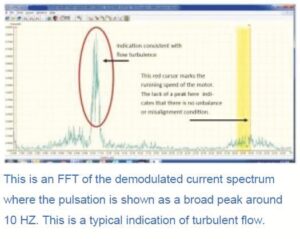
Test results revealed
– The motor has perfect electrical performance, with balanced current and voltage and a power factor exceeding 90.
– The motor and pump have excellent mechanical performance, with no misalignment or imbalance, bearing problems, rotor or stator problems.
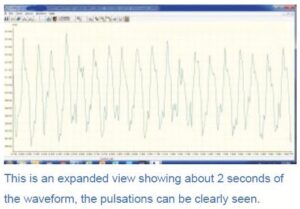
Tests showed that the current fluctuated significantly, with a pulsation frequency of approximately 10 Hz. Dunn and his team determined that this was caused by non-laminar or turbulent flow in the system.
The turbulence observed on two underperforming vertical water pumps was astonishing; even more surprising to the maintenance team was that no other tests detected any turbulence. Only electrical characterization revealed the root cause of the pump’s poor performance.
One of the main advantages of electrical characterization is its ability to reveal mechanical problems driving the load, even in vertical pumps with impellers under 30 feet. Furthermore, it provides detailed information about the entire system, including both electrical and mechanical aspects.
Once the maintenance team understands the root cause of the performance problem, they can take the necessary remedial measures to bring the pumps back to the performance requirements of the nuclear power plant.
Summarize
Predictive maintenance is very important.
Monitoring industrial equipment and assessing performance issues before catastrophic failures can help your operations avoid costly downtime and unnecessary expenses.
If you are responsible for critical motor drive assets, the ATPOL III™ is a powerful monitoring and diagnostic device, and this case study demonstrates that the ATPOL III™ is a great tool for vibration measurements.
Performing electrical signal analysis concurrently with vibration analysis provides a deeper understanding of the equipment’s true condition. For any condition-based/predictive maintenance program, ensuring access to the appropriate tools to conduct such analyses is crucial.
Safety is key
Using the handheld ALL-TEST PRO On-Line III™ instrument makes power-on testing safer because it incorporates wireless Bluetooth* technology, allowing operators to maintain a safe distance from powered equipment. The ALL-SAFE PRO® junction box can also be installed to further enhance operator safety during data acquisition. Invest in the tools needed to ensure people’s safety.
About ALL-TEST Pro, LLC
ALL-TEST Pro enables true motor maintenance and troubleshooting with innovative diagnostic tools, software, and support, allowing you to keep your business running smoothly.
About I & E Central
Founded in 2001 by Bob Dunn, I&E Central is a distributor of industrial test equipment designed for predictive maintenance (PdM), electrical, and reliability professionals. Headquartered near Rochester, New York, I&E Central represents products from numerous well-known manufacturers, providing support for power quality monitoring, vibration monitoring, ultrasonic testing, motor testing, laser alignment, thermal imaging, and more. For more information about its products and services, please visit www.ie-central.com.