诊断出发电机相位不平衡,为公司节省 100 万美元
illustrate
Location: Vermont Yankee Nuclear Power Plant
Factory equipment: 50 hp, 3600 rpm, 480 volt, open-type drip-proof cooling pump motor
Affected system: 500 MW generator bearing cooling
Cost of failure: $1,000,000
Balance: > $1,000,000
A 50 hp, 3600 rpm, delta-connected electric motor was installed on the Vermont Yankee generator bearing cooling pump, and its rotation was checked. It is one of two motors that only starts in the event of a main motor failure. When the main unit fails, the motor is switched on. The results showed a current imbalance rate of 11% (pp), while the voltage imbalance rate was less than 0.5%. Although the peak current indicated the motor was operating at 90% load, it still exhibited 120 Hz vibration (electrical) and excessively high operating temperature.
Preliminary readings
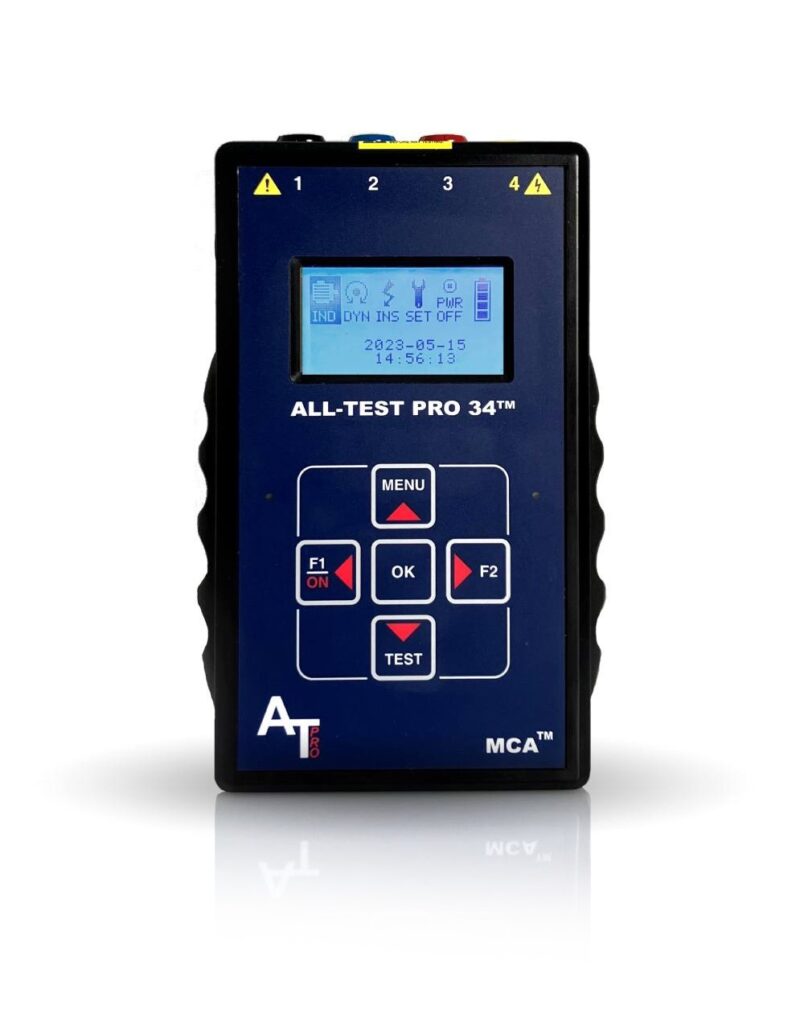
Phase imbalance was measured using ALL-TEST III™. When the rotor reached the peak imbalance value for each phase, the phase imbalance results were 000, -016, and -016 (imbalance percentage), respectively. Two more motors of the same model and similar serial numbers were selected for review, and tests were performed using ALL-TEST IV PRO™ 2000 and ALL-TEST III™. The resulting phase imbalance and rotor test results were evaluated (Figure 1 and Table 1 show examples of common results):
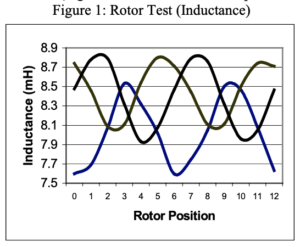
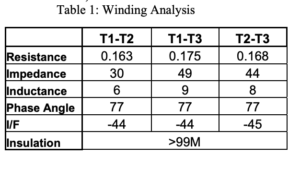
The imbalance was found to be very significant, related to unbalanced current, vibration, and motor heating. Various possibilities, ranging from power quality to test equipment calibration, were explored. All of these were satisfactory.
Next step
We contacted the motor manufacturer, who pointed out a change in the manufacturing process of a large concentric winding machine at a specific location. In motors of this size and speed, the first set of concentric coils (one phase) would coil below subsequent phases, reducing the winding appearance and mechanical strength of the equipment. To address this, the manufacturer decided to significantly increase the size of the first set of coils in the automated process (stage one), precisely where this set of coils is furthest from the rotor. This way, the coil ends appear without post-winding modifications. Aside from the “design compliance” applied voltage impedance test, no dynamometer testing, full-load testing, or other tests were performed on the motor design. Inductance is directly affected by rotor distance, conductor count, and coil size. The improvement in the motor manufacturing process caused an imbalance.
Motors from other manufacturers were evaluated and found to have balanced windings. However, several new motors were found to have voids in the rotor castings, which would affect the motor’s ability to generate torque.
Vermont Yankee Nuclear Power has implemented a program to test all received critical motors using the ALL-TEST III™ and ALL-TEST IV PRO™ 2000 combination prior to acceptance.
Avoid costs
The generator must be shut down within two minutes of the second generator failure. An emergency shutdown could damage the generator bearings and cause an unexpected power outage. It was estimated that the cost of avoiding the failure by detecting it far exceeded $1 million. Subsequent discovery of similar generator conditions through new and repaired generators further validated the rationale for the incoming testing and inspection program.
Summarize
New and repaired motors are not immune to defects. These defects may be caused by manufacturing/repair errors or design flaws. These potentially costly faults can be identified through incoming inspection using ALL-TEST III™ and ALL-TEST IV PRO™ 2000 before equipment installation.