
Éliminer le déséquilibre de tension
Voltage imbalance degrades the performance and reduces the lifespan of a three-phase motor. A voltage imbalance across the motor terminals can cause a current imbalance far exceeding the voltage imbalance. Unbalanced currents lead to torque pulsations, increased vibration and mechanical stress, increased losses resulting in reduced efficiency and motor overheating, which in turn reduces the lifespan of the winding insulation.
The percentage voltage imbalance is defined by the National Electrical Manufacturers Association (NEMA) as 100 times the absolute value of the maximum deviation of the line voltage from the average voltage on a three-phase system, divided by the average voltage. For example, if the measured line voltages are 462, 463, and 455 volts, the average is 460 volts. The voltage imbalance is:
(460 – 455) / 460 x 100 = 1.1%
It is recommended that voltage imbalances across the motor terminals not exceed 1%. Imbalances greater than 1% require motor derating, in accordance with Figure 20-2 of NEMA MG-1-2011, and void most manufacturers’ warranties. Common causes of voltage imbalance include the following
– Malfunctioning power factor correction equipment
– Unbalanced or unstable power supply
– Bank of unbalanced transformers supplying a three-phase load that is too large for the bank.
– Single-phase loads unevenly distributed on the same electrical network
– Unidentified single-phase earth faults
– An open circuit on the primary distribution network
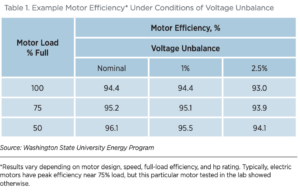
The efficiency of a 1800 rpm, 100 hp motor is given as a function of voltage imbalance and motor load in Table 1 below. A general trend of reduced efficiency with increasing voltage imbalance is observed for motors under all load conditions.
Voltage imbalance is likely the primary power quality issue leading to overheating and premature motor failure. If voltage imbalances are detected, a thorough investigation should be conducted to determine the cause. Energy and cost savings are achieved when corrective measures are implemented.
Suggested actions
- Periodically check the voltages across the motor terminals to ensure that the voltage imbalance remains below 1%. Consider installing sensors that trigger alarms for unacceptable values or rates of change. ISA100 wireless sensor networks may be a suitable option.
- Check the single-line diagrams of your electrical system to ensure that single-phase loads are evenly distributed.
- Install ground fault indicators as needed and perform annual thermographic inspections. Vibrations of 120 hertz (Hz) are another indicator of voltage imbalance. The detection of a 120 Hz vibration should prompt an immediate voltage balance check.
Example of energy savings in case of voltage imbalance
Assume that the 100 hp motor tested as shown in Table 1 was fully loaded and operated for 8,000 hours per year (h/year), with a voltage imbalance of 2.5%. With an energy price of $0.08/kilowatt-hour (kWh), the annual energy and cost savings after implementing the corrective measures are as follows:
Annual energy savings = 100 hp x 0.746 kW/hp x 8,000 h/year x (100/93 – 100/94.4) = 9,517 kWh
Annual savings = 9,517 kWh x $0.08/kWh = 760
The overall savings can be much greater because an unbalanced supply voltage can power many motors and other electrical equipment.
Other considerations
Voltage imbalance results in extremely high current imbalance. The magnitude of the current imbalance can be 6 to 10 times greater than that of the voltage imbalance. For the 100 hp motor in the previous example, the line currents (at full load with a 2.5% voltage imbalance) were 27.7% unbalanced.
A motor will run hotter if it is powered by an electrical supply with a voltage imbalance. The additional temperature increase is estimated using the following equation1:
Total temperature increase = Balanced temperature increase x (1 + 2 x (% voltage imbalance)2 /100)
For example, a motor whose temperature increases by 80°C due to resistance will experience a temperature increase of 6.4°C when operating under 2% voltage imbalance conditions. The winding insulation life is halved for every 10°C increase in operating temperature.2
Resources
National Electrical Manufacturers Association (NEMA) – Visit www.nema.org for more information on voltage imbalances.
U.S. Department of Energy (DOE) – For more information on the efficiency of motors and motorized systems and to download the MotorMaster+ software tool, visit the Advanced Manufacturing Office (AMO) website at manufacturing.energy.gov.
References
Reliance Electric, “Power Supply”, September 1998.
2. “Stopping a Costly Leak: The Effects of Unbalanced Voltage on the Lifespan and Efficiency of Three-Phase Electric Motors.” Energy Issues. U.S. Department of Energy. Winter 2005.
Additional references
The information in this tip sheet is taken from NEMA Standards, Motors and Generators publication MG-1-2011, available for purchase at www.nema.org.
AT34™
Analyse et tendance de l’intégrité des composants du moteur pour les défauts de mise à la terre, les défauts de bobinage interne, les connexions ouvertes et la contamination – le tout avec un seul appareil portatif.

Séminaire en ligne sur le diagnostic automobile de classe mondiale – Niveau 1 – 12-16 juin
Avez-vous entendu ? Nous organisons notre séminaire de diagnostic automobile de niveau 1 du 12 au 16 juin. Il s’agit d’un séminaire en ligne/virtuel qui débutera chaque jour à 8 […]

Préconlub 15-16 juin 2023 Leon, Mexique
Venez rejoindre Gloria Urizar, directrice régionale de l’ATP pour la région LATAM, lors de sa présentation au Preconlub 2023 ! Plus d’informations : https://www.preconlub.com/ […]