通过电气信号分析进行在线电机测试
Online motor testing 101
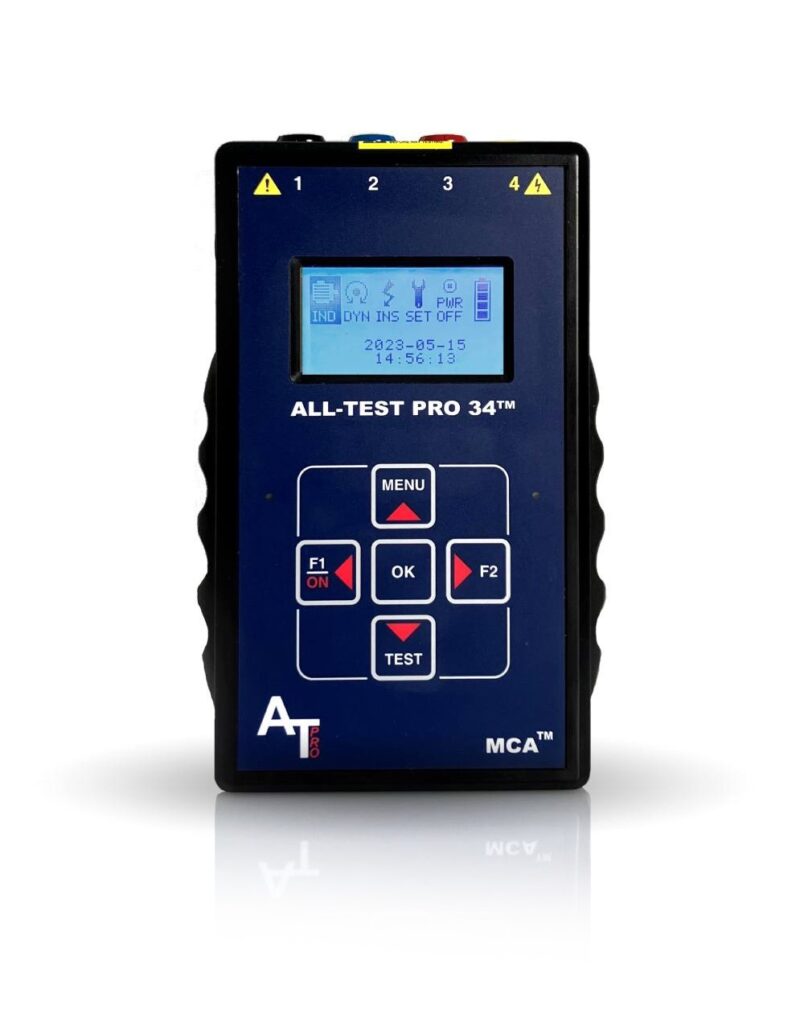
Electrical Signal Analysis (ESA) is an online testing method that captures voltage and current waveforms while the motor system is running, and then performs spectral analysis using Fast Fourier Transform (FFT) software. This FFT allows for the detection of faults related to the input power supply, control circuitry, the motor itself, and the drive load, and enables trend analysis for condition-based/predictive maintenance. Our specialized ESA instruments are handheld, portable, and battery-powered.
All ESA analysis systems require the voltage, operating speed, full-load current, and horsepower (or kilowatts) information from the motor nameplate. Additionally, optional information such as the number of rotor shafts and stator slots, bearing numbers, and information on driven load components, such as the number of fan blades or gearbox teeth, can be entered for more detailed and accurate analysis.
Online power-on testing provides valuable information for AC induction and DC motors, generators, wound-rotor motors, synchronous motors, machine tool motors, and more. Since many people are unfamiliar with ESA, the following diagram illustrates ESA’s evaluation capabilities for key components of motor systems.

It can also perform power quality analysis.
- Power quality data recording
- 3-channel voltage and 4-channel current recording
- Event waveform capture ≥ 1/2 cycles
- Transient event detection time ≥ 8 microseconds
- Energy data recording – 63rd harmonic (V and I) analysis
- Phase Graph – Preset and easy-to-use report template
- The before-and-after analysis function reports energy-saving status.
Online testing using electrical signal analysis
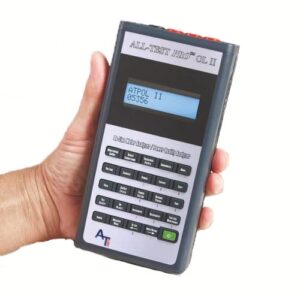
All Test Items II (ATPOL IITM)
- European Space Agency
- Power quality
- Sagging and swelling
- Waveform capture
- Energy data recording
Successfully applied to the European Space Agency
- AC/DC motors
- Motor drive applications
- Generator/Converter
- Traction motor
- Machine tool motor
- gearbox
- Pumps and fans
- reliability
- For debugging
- Used for troubleshooting
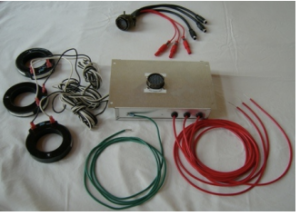
The ALL-SAFE PRO™ junction box allows technicians to collect online test data without opening the power panel.
Automatic fault detection
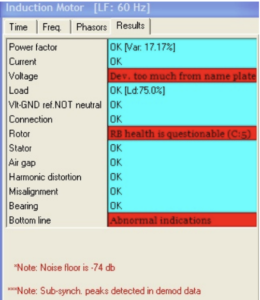
Below is a brief example of an AC induction motor with a squirrel-cage rotor.
Data is collected using portable voltage and current probes or a permanently mounted junction box (ALL-SAFE PRO™).
The collected data is then analyzed using the provided software.
Alarms are preset for AC induction motors, synchronous motors, DC motors, and transformers, and automatic reporting templates are provided.
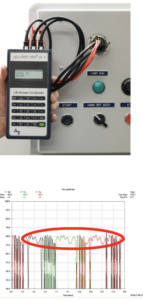
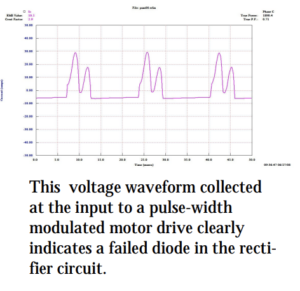
Excessive ripple on this voltage waveform indicates a faulty capacitor in the pulse-width modulation (PWM) motor driver. For more information on testing PWM motor drivers using ESA, please email [email protected].
Call Analysis
- Power factor
- Current and voltage imbalance
- Nameplate RMS voltage
- Peak voltage and current and peak factor
- Phase impedance
- Power (apparent power, actual power, and reactive power)
- Total harmonic distortion (voltage and current)
Motor power analysis
- Load to nameplate
- THDF (Transformer Harmonic Degradation Factor)
- VDF (Voltage Derating Factor)
- The product of THDF and VDF can be used to reduce the horsepower rating.
- Demand Dynamics
- Total negative sequence, positive sequence and zero sequence harmonics
- Efficiency of AC induction motors and DC motors
- * Can be used with the U.S. Department of Energy’s Motor Master+ software program to make repair or replacement decisions. MM+ will also calculate the return on investment if upgrading to an energy-efficient motor.
Motor Analysis
- line frequency
- Running speed
- Extreme passband
- Rotor health
- Air gap (static and dynamic eccentricity)
- Errors/imbalances
- Stator Electric
- Stator machinery
- Phase connection health
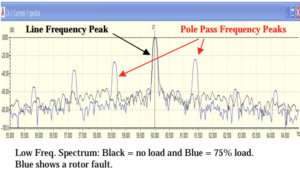
The analysis software offers a comparison function, allowing one spectrum to be superimposed onto another for comparison. The figure below shows the FFT spectrum of the motor at no-load and 75% load. The smaller blue peaks flanking the large blue peak are called pole frequencies. These peaks are caused by multiple rotor fractures.
Load Analysis
After inputting the information into the software, the mechanical system can be analyzed.
- direct connection
- gearbox
- belt style
- Fan blades
- impeller
More details about online analytics
One of the main operations of the ATPOL II software is to perform root mean square demodulation on the power line carrier signal to provide a highly sensitive and selective method for extracting the current signal of the motor load. After demodulating the raw current signal, large line frequency components can be removed, thereby greatly improving the signal-to-noise ratio of the components that cause modulation (such as running speed, belt drive, gear meshing, etc.).
Numerous performance metrics are displayed in both the time and frequency domains, providing the necessary information to determine the motor’s “health” and the impact of the delivered load. This allows for a real “view” of the actual operating speed, motor slip frequency, gear meshing frequency, transmission system components, and gear speeds.
To separate the various frequencies, a Fast Fourier Transform (FFT) is used, and the resulting spectrum is displayed on the screen. The peaks in the spectrum correspond to the rotational speeds of different components in the machine. For example, in the case of a fan driven by a motor via a belt, the peaks correspond to the motor speed, the frequency of magnetic pole passing, the fan speed, and the belt speed. If a gearbox is used instead of a belt drive, then the spectral peaks will appear at the gear speed and the gear meshing frequency.
The height of these spectral peaks depends on two factors: the overall current level of the motor and the amplitude of mechanical disturbances originating from the machine and sensed by the motor. Mechanical disturbances initially manifest as torque variations, eventually appearing as minute speed changes in the motor, leading to minute current fluctuations. With the total speed constant, variations in the peak fan speed indicate a deterioration in the fan’s mechanical condition. By observing these changes, faults such as imbalance, misalignment, drive wheel wear, or bearing damage can be easily detected. Therefore, after periodic data collection, frequency displays can be used to monitor motor-driven machinery, providing early warnings of potential performance degradation.
The main difference between Motor Current Characteristic Analysis (MCSA) and Electrical Characteristic Analysis (ESA) is that MCSA performs an FFT on the current waveform, not the voltage. This makes it more difficult to easily and quickly distinguish between problems related to the input power supply and problems with the motor and drive load. With ESA, you can see both current and voltage FFTs on the same screen. Therefore, you can identify the fault source simply by comparing the voltage and current FFT spectra.
Generally, if a peak dominates the voltage spectrum, the source of the peak is the motor. If a peak dominates the current spectrum, the source is related to the motor or the load.
ESA Failure Mode
Fault type:
Stator mechanics: CF = RS x stator slot with low-frequency sideband
Static eccentricity CF = RS x rotor crossbeam with LF and 2LF sidebands
Mechanical imbalance/misalignment is addressed using a proprietary algorithm.
Dynamic eccentricity CF = RS x rotor rod LF and 2LF side belt, plus RS side belt
Stator electrical (short circuit) CF = RS x stator slot LF sideband and RS sideband
CF = Center Frequency; RS = Operating Speed; LF = Line Frequency