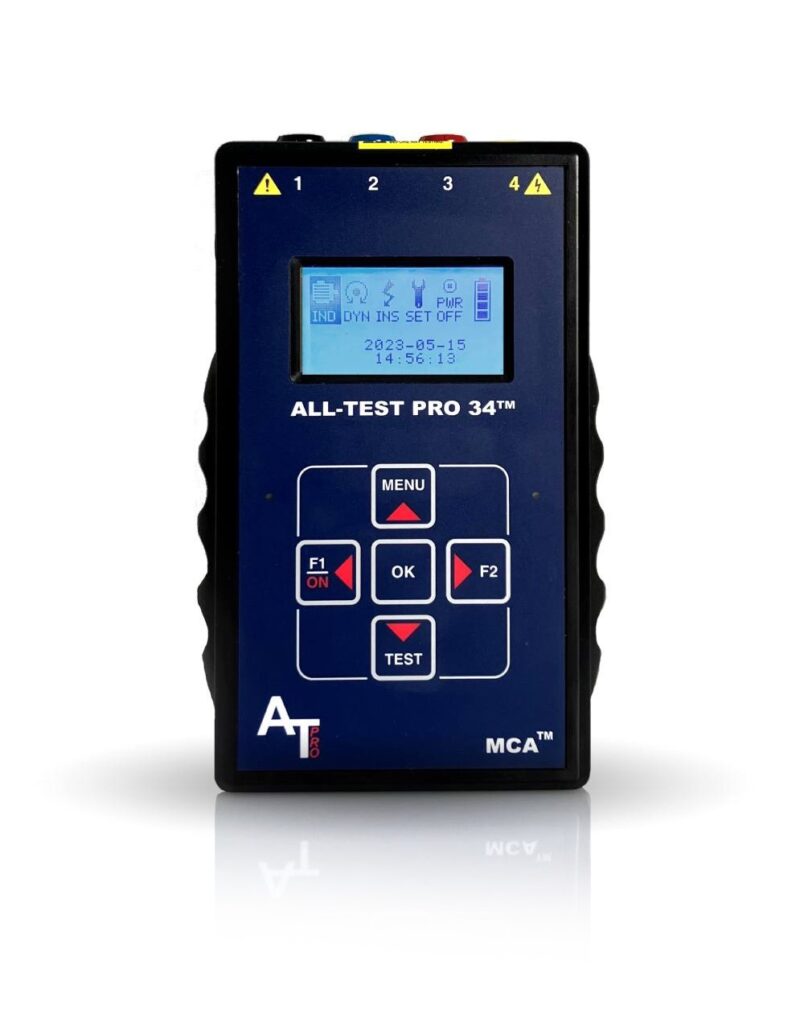
电机电路分析可提高能效、可靠性和生产成本
Introduction
News reports indicate that due to power outages caused by increased electricity demand, controlling energy costs is no longer seen as a green option, but rather as a survival strategy. In the industrial sector, energy control through motor system energy strategies holds the greatest potential.
In the United States, electric motors consume 19% of all energy and 57% of all electricity generated. Over 70% of the electricity used in manufacturing and 90% in processing is consumed by electric motors. Motor retrofitting, variable frequency drive applications, and other energy efficiency strategies have received encouraging attention. However, two areas are often overlooked in improving energy efficiency: maintenance and reliability.
According to EPRI, the efficiency of mechanical equipment can generally be improved by 10-15% through proper maintenance. This includes preventative, predictive, proactive, and corrective maintenance programs. In particular, the continuous application of motor circuit analysis (MCA) can help avoid motor failures, enable proactive maintenance or replacement, and improve the overall energy efficiency of motor systems.
Energy costs alone cannot always justify the rationale for a motor maintenance program. However, when combined with productivity and associated reliability costs, an MCA (Mechanical, Control, and Automated) program can immediately justify its rationale. For example, consider a factory production line with a 100-horsepower main drive motor, accounting for 10% of total output, operating for 6,000 hours per year. If the factory were to shut down 100%, the downtime cost would be $25,000 per hour. In the event of a catastrophic failure, motor replacement would take 6 hours, while startup would take 2 hours. With the motor at 75% load, energy costs would be $0.06/kWh and $14/kW, and a 5% impedance imbalance would be detected. Excluding wasted products, the total additional cost annually would be $24,875. 93.6% of this would be due to production losses, 3.1% due to increased power consumption, 1.2% due to shortened motor life, and 2.1% due to increased demand costs (Figure 1).

Motor circuit analysis description
The basic concept of MCA is to give analysts the opportunity to examine simple resistance (R), composite resistance (Z-impedance), inductance (L), phase angle (power factor), ground insulation condition (Meg-Ohms), and other tests to determine the condition of the motor windings. For safety and accuracy, these readings are best obtained with the equipment powered off.
In principle, a motor circuit consists of a series of resistors (including simple and complex resistors), inductors, and the resulting phase angles, each differing by 120 degrees in a three-phase system (Figure 2). When the three-phase windings are imperfect due to original defects or impending faults, they become unbalanced according to the laws of physics. In an assembled motor, casting voids or broken bars in the rotor, poor air gaps, or bent shafts can all cause variations due to mutual induction between the stator and rotor.
MCA (Mechanical Control Analyzer) devices can read the mutual inductance between the stator and rotor, enabling analysts to effectively, quickly, and safely detect defects in the rotor or air gap. Most MCA devices can operate on motors ranging from zero horsepower to over 10,000 horsepower and from 12 volts to over 13.8 kV, thus offering a wide operating range. However, they should not be confused with RCL (Resistance, Capacitance, and Inductance) meters, which only provide resistance, capacitance, and inductance readings and often include megohmmeter or polarization index testing. Furthermore, the price of a high-quality MCA device (including software) is well under $10,000, making it a very cost-effective proactive maintenance tool.
A key difference between RCL and MCA power meters lies in their impedance readings. Since current equals the voltage across the impedance, voltage and current imbalances are inversely proportional in AC applications. This is a crucial distinction, as much work has been done on the economic impact of voltage imbalances. While simple resistance can determine the I²R loss at a point, it cannot determine system reliability; similarly, inductance alone cannot determine system reliability because it varies with winding design and rotor-to-winding position. Unfortunately, inductance-based systems often fail even good motors and windings. To obtain a true picture of the motor windings, all motor circuit components must be examined, including resistance, impedance, inductance, phase angle, and insulation resistance. At least one MCA equipment manufacturer has added a special test that doubles the application frequency and examines the resulting ratios between windings. This allows for early detection of faults between turns and between coils that might otherwise go undetected.
The impact of methyl chloroform on energy
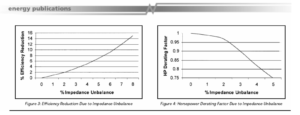
The function of an electric motor is to convert electrical energy into mechanical torque. It operates optimally when the three phases are 120 degrees out of phase and stator, rotor, and friction losses are controlled. When the phase difference reaches 120 degrees, the motor’s efficiency decreases because the magnetic field becomes more difficult to rotate the rotor. When the deviation is large enough, they begin to interfere with each other. Both voltage imbalance and impedance imbalance have this effect, impacting efficiency, reliability, and production. Similar to voltage imbalance, 1-2% imbalance is acceptable, but it should not exceed 5%, as the temperature rise will exceed 50% at this point. When the impedance imbalance exceeds 2%, the motor should be derated as shown in Figure 4.
One significant impact of impedance imbalance is on energy efficiency and related costs. A simplified energy calculation for motor efficiency is as follows:
Formula 1:
Kilowatt loss kilowatt = horsepower * 0.746 * load * [(100/E1) – (100/E2)] .
Where: hp is horsepower, E1 is the new efficiency, and E2 is the original efficiency.
Formula 2:
Cost per kilowatt per year = kilowatt/dollar * kilowatt * 12 months/year
Formula 3:
Energy cost per kilowatt-hour per year = kilowatt-hours/dollars * hours/year * kilowatt-hours
The impact of impedance imbalance on efficiency is shown in Figure 3. A 50 hp energy-efficient electric motor, operating at 1800 RPM with 95% efficiency and 85% load, running for 6000 hours per year, has an impedance imbalance of 3.5% and an efficiency of 91%. With an average energy cost of $0.06/kWh and an average demand cost of $14/kWh, the resulting energy costs are as follows:
Example 1: A 50-horsepower motor with an impedance imbalance rate of 3.5%.
50 hp * 0.746 * 0.85 * [(100/91) – (100/95)] = 1.47 kW
$14/kW * 1.47 kW/month * 12 months/year = $246.96/year
$0.06/kWh * 6000 hours/year * 1.47 kW = $529.20/year
Total annual energy cost = US$776.16/year
The increased energy costs from operating this motor each year are substantial. As more motors are introduced, impedance imbalances within the factory will become more severe. This will lead to reduced efficiency, and consequently, impact the reliability of the motor system and overall production.
Impact of Common Country Assessment on Reliability
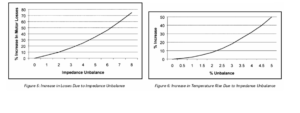
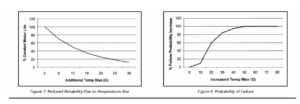
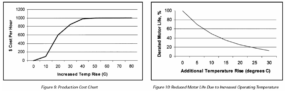
The impact of MCA on reliability: The direct consequence of impedance imbalance is increased motor operating temperature and electromechanical stress within the motor windings and rotor. Figure 5 shows the increase in losses, Figure 6 shows the impact on operating temperature, and Figure 7 shows the decrease in motor reliability. It is important to understand that identifying phase imbalance or potential winding faults does not predict motor failure. Testing can be tracked and trend analyzed to determine how much reliability or confidence in the motor’s design performance will decrease, allowing the owner to decide on motor repair or replacement. This tolerance should be relatively large for non-critical motors and smaller for critical equipment.
For the same 50-horsepower motor, if the impedance imbalance rate is 3.5%, the reliability loss is as follows:
Losses increased by 20%.
The temperature rises by 25%. For a motor with a rated ambient temperature of 40 degrees Celsius and insulation class F, the normal temperature rise under 85% load when operating in an environment of 22 degrees Celsius is 80 degrees Celsius. A 25% increase will raise the new temperature to 100 degrees Celsius, or a temperature rise of 20 degrees Celsius.
For every 20-degree Celsius increase in temperature, the potential lifespan of an electric motor is reduced to 25% of its original value (for every 10-degree Celsius increase in temperature, the lifespan of insulation is halved). This does not include any other potential effects on the insulation system or the transfer insulation system.
Impact of MCA Testing on Production
The direct impact of increased energy costs and reduced reliability on production depends on the criticality of the motor to operation. For example, the main drive unit of a production line is critical, while the air handling unit may have a negligible impact on production. As the probability of failure increases, production costs can be estimated. According to Figure 9, a production cost estimate of $1,000 per hour can be determined, taking into account the extent to which production will be affected, as well as the potential downtime and start-up time if an unexpected motor failure occurs.
A 50-horsepower electric motor with an impedance imbalance rate of 3.5% has a 60% failure rate, resulting in a potential production loss of $600/$1000. Therefore, if a critical 50-horsepower motor has a 100% impact on a production line costing $5000 per hour, with a downtime of 4 hours and an uptime of 1 hour, the impact cost would be a potential loss of $15,000.
Equation 4: Production Loss
$600 / $1000 * $5000 * 4 hours * 1 hour = Production loss of $15,000
The comprehensive analysis of the example used in the article employs a significant 50-horsepower electric motor with an impedance imbalance of 3.5%. The total potential cost associated with this impedance imbalance is…

To avoid potential costs, the motor can be repaired or replaced. If the motor is disassembled and replaced during the next shutdown:
The cost of replacing a 95% high-efficiency motor: $2,250
Replacement labor cost: $500
Original price of MCA testing equipment: $7,995
Testing time (5 minutes, $60/hour): $5
Total: $10,750
Simple payback period: 0.68 years or 8 months
Excluding testing equipment costs: 0.17 years or 2 months
Once the new motor arrives at the factory, a reliability check should be performed to ensure that there are no manufacturing defects.
Summarize
Motor circuit analysis is a powerful, easy-to-use, and inherently safe (offline testing) tool. The testing scope and potential returns are almost immediate. The example used in this article represents only one motor in a factory. If analysis identifies more motors requiring attention, the initial purchase and implementation of the MCA program will yield immediate results, considering energy and production costs. Implementing such a program as an in-house initiative or service is very straightforward:
MCA Training – Basic operation of most systems requires only 1 to 8 hours of in-house training; the learning curve for advanced analytics is reasonable.
Identify the critical motors – motors that are essential to operation.
Analyze the selected motor and determine the results.
Key motors should be tracked and trend analyzed at least quarterly (and monthly if possible).
Implementing opportunities
Expand the testing scope based on success.
The results of the MCA program, combined with other forward-looking maintenance systems, will produce outstanding effects in energy conservation, improved reliability, and production uptime.
bibliography
Sarma, Mulukutla S., Electric Machines: Steady-State Theory and Dynamic Performance, PWS Publishing Company, 1994.
Nasar, Syed A., Theory and Problems of Electric Machines and Electromechanics, Schaums Outline Series, 1981.
Edminster, Joseph, et al., Circuits, 3rd Edition, Schaum’s Electronic Tutor, 1997.
Hammond et al., Engineering Electromagnetism, Physical Processes and Computation, Oxford Science Press, 1994.
Penrose, Howard W., “Repair Specifications for Low-Voltage Multiphase Induction Motors for PWM Inverter Applications”, Kennedy-Western University, 1995.
Penrose, Howard W., A Novel Approach to Total Motor System Maintenance and Management for Improved Uptime and Energy Costs in Commercial and Industrial Facilities, Kennedy-Western University, 1997.
Penrose, Howard W., A Novel Approach to Industrial Assessments for Improved Energy, Waste Stream, Process and Reliability, Kennedy-Western University, 1999.
Penrose, Howard W., Anatomy of an Energy Efficient Electric Motor Repair, Electrical Insulation Magazine, January/February 1997.
“A Phase Frame Analysis of the Influence of Voltage Imbalance on Induction Motors,” *IEEE Transactions on Industrial Applications*, Vol. 1, No. 2, Mar/Apr 1997, p. 415.
Bonnett, Austin A., How to Analyze Rotor and Stator Failures for Three-Phase Squirrel Cage Induction Motors, EASA Conference, 1997.
Varatharasa, Logan, et.al., Simulation of Three-Phase Induction Motor Performance During Faults, EIC/EMCW Conference 1998 CD Rom.
U.S. Department of Energy et al., Keeping the Spark in Electrical Systems, U.S. Department of Energy, October 1995.
About the author
Dr. Howard W. Penrose has over 15 years of experience in the electric motor and motor repair industry. Starting as an electrical repair technician in the U.S. Navy, he progressed to field service and evaluation of all types of small to large rotating equipment, serving as chief engineer at a large Midwestern motor repair shop. Dr. Penrose has been directly involved in the rewinding, training, and troubleshooting of AC, DC, wound rotor, synchronous, machine tool, and specialty equipment. His further research focuses on motor and industrial reliability, testing methods, energy efficiency, and the impact of maintenance on production. Dr. Penrose is a former president of the IEEE Chicago Chapter, a former president of the IEEE Chicago Chapter’s Dielectrics and Electrical Insulation Society, a professional member of the Electrical Manufacturing Coils and Windings Association, and a U.S. Department of Energy certified electrical master professional, vibration analyst, infrared analyst, and motor circuit analyst.